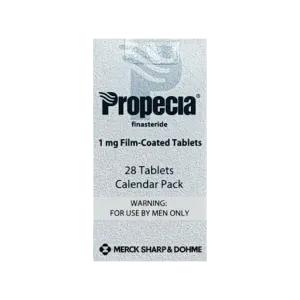

What is Propecia 1mg?
Propecia is the branded Organon Pharma (UK) Limited version of finasteride 1mg. It is a prescription-only film-coated tablet licensed for male pattern hair loss in adult men. Each tan, eight-sided tablet is marked with a P logo on one side and PROPECIA on the other.2
Propecia may help maintain existing scalp hair and may support regrowth in some men, but individual results vary. It is not suitable for every type of hair loss and does not work for everyone.2
Buy Propecia online in the UK
Choose this item after your consultation if you specifically want genuine branded Propecia. Hightown's displayed price includes the confidential clinical assessment and private prescription. Ordering does not guarantee supply: a qualified prescriber must confirm that the medicine is appropriate for you.
- Select your preferred pack and complete the online hair-loss consultation.
- A prescriber reviews your health, medicines and pattern of hair loss.
- If approved, Hightown dispenses branded Propecia for discreet UK delivery.
Who may be suitable for Propecia?
Hightown's Propecia service is for men aged 18 or over whose history and pattern of thinning are consistent with male pattern hair loss.
This service may be suitable if
- You are an adult man with gradual thinning around the hairline, top of the scalp or crown.
- Your scalp is otherwise healthy and the likely cause is male pattern hair loss.
- You understand that visible improvement is not guaranteed and continued treatment is normally needed to maintain benefit.
- You will take the medicine exactly as prescribed and report relevant side effects.
Propecia must not be used, or needs further review, if
- You are a woman, child or adolescent.
- You are allergic to finasteride or another tablet ingredient.
- You already take Proscar, another finasteride medicine or another 5-alpha reductase inhibitor.
- Your hair loss is sudden, patchy, associated with an inflamed scalp or otherwise unexplained.
Tell the prescriber about your medical history, including mood changes, sexual symptoms, fertility concerns, liver problems and any planned PSA blood test.
Propecia or generic finasteride?
Propecia and the lower-cost generic finasteride 1 mg tablets supplied by Hightown Pharmacy contain the same active ingredient, finasteride, at the same 1 mg strength. To be authorised in the UK, a generic medicine must contain the same active substance, have the same pharmaceutical form and demonstrate bioequivalence to the original reference medicine.8
| Feature | Propecia | Generic finasteride |
|---|---|---|
| Active ingredient | Finasteride 1mg | Finasteride 1mg |
| Product identity | Branded Propecia | Manufacturer may vary |
| Appearance | Tan, eight-sided branded tablet | Appearance and inactive ingredients may vary |
| Price | Branded price shown above | Usually the lower-cost option |
Choose Propecia if you prefer the original branded medicine. If the brand is not important to you, generic finasteride 1 mg is usually the more cost-effective option. Do not take Propecia and generic finasteride together, as they contain the same active ingredient and strength.
For a broader explanation, read our guide to branded and generic medicines.
For the full evidence base, dosing detail and a side-by-side comparison, see our finasteride 1mg tablets page.
How does Propecia work?
Finasteride inhibits type II 5-alpha reductase, reducing the conversion of testosterone into dihydrotestosterone, or DHT. DHT contributes to progressive miniaturisation of scalp hair follicles in male pattern hair loss. Reducing DHT may slow further thinning and support regrowth, but it does not predict an individual's response.
Finasteride lowers serum DHT within 24 hours, but hair changes take much longer to assess because the hair-growth cycle is slow.2
Does Propecia work for male pattern hair loss?
Clinical studies support finasteride 1mg for selected men with mild to moderate male pattern hair loss. The most useful outcome is whether hair is improved or maintained over time, not a blanket "success" or regrowth percentage.
| Evidence | What it found | Important context |
|---|---|---|
| Propecia five-year product data | At five years, standardised photographs rated 48% of treated men as improved and another 42% as unchanged.2 | This is 90% improved or maintained, not 90% regrowth. Results came from selected trial participants and do not guarantee an individual outcome. |
| 1998 randomised trials | Finasteride 1mg improved hair-count and clinical-assessment outcomes compared with placebo over two years.9 | The studies enrolled men with defined patterns and severity of hair loss. |
| 2002 five-year extension | Longer follow-up supported sustained benefit with continued finasteride treatment.10 | Long-term completers may differ from people who stop treatment earlier. |
| 2010 systematic review | The review of 12 studies found finasteride improved patient and investigator hair assessments compared with placebo.11 | Benefits must be considered alongside sexual and other adverse effects. |
When might I notice results?
Generally, three to six months of once-daily treatment are needed before stabilisation can be expected. Some people need longer before they can judge a visible change, and treatment should be reviewed if it does not appear to be helping.2
Take progress photographs in similar lighting and from the same angles so that gradual changes are easier to compare. Continued treatment is usually required to maintain the benefits. If you stop taking finasteride, any improvement may begin to reverse within around six months, with your hair generally returning towards its previous level within 9 to 12 months.2
How to take Propecia
- Take one 1mg tablet once daily if that is the dose on your pharmacy label.
- Swallow the tablet whole. It can be taken with or without food.
- Do not take more than one tablet daily; a higher dose has not been shown to increase effectiveness for hair loss.
- If you miss a dose, skip it and take the next tablet at the usual time. Do not take a double dose.
Follow the directions supplied with your prescription and read the patient leaflet in your pack.
Side effects and current mental-health advice
In the first 12 months of the clinical studies, decreased libido was reported by 1.8% taking Propecia and 1.3% taking placebo; erectile dysfunction by 1.3% and 0.7%; and decreased ejaculate volume by 0.8% and 0.4%. Across drug-related sexual effects, the reported rate was 3.8% with finasteride 1mg and 2.1% with placebo.2
These effects resolved after stopping in some participants and in many who continued, but persistent sexual dysfunction has also been reported after treatment ended. Contact a healthcare professional if you experience reduced sex drive, erection or ejaculation problems.24
Stop Propecia and contact a healthcare professional as soon as possible if you develop depressed mood, depression or suicidal thoughts. If you have seriously harmed yourself or feel at immediate risk, call 999 or go to A&E. You can also contact NHS 111 for urgent advice or the Samaritans free on 116 123.4
Seek urgent help for signs of a serious allergic reaction. Promptly report breast lumps, pain, enlargement or nipple discharge. Other reported effects and their frequencies are listed in the patient leaflet.2 Report suspected medicine side effects through the MHRA Yellow Card scheme.
Pregnancy, fertility and PSA tests
- Women must not take Propecia. Women who are pregnant or may become pregnant should not handle crushed or broken tablets. Intact film-coated tablets prevent contact during normal handling.2
- The SmPC reports that less than 0.001% of a 1mg dose was detected in semen per ejaculation and describes this amount as unlikely to pose a risk to a developing male baby. Tell the prescriber if you have concerns about a pregnant partner.2
- Long-term human fertility data are limited. Poor semen quality and infertility have been reported, with improvement after stopping in some reports. Discuss concerns if you are trying for a baby.2
- Propecia can lower PSA results. Tell the clinician arranging or interpreting a PSA test that you take finasteride.2 The tablets also contain lactose.
Can Propecia be used with minoxidil?
A healthcare professional may approve finasteride with topical minoxidil because they work in different ways. A 2020 systematic review found that combined finasteride and topical minoxidil produced better global photographic and marked-improvement outcomes than either treatment alone across the included studies, although the evidence had limitations.12
Topical options include Regaine for Men Extra Strength Solution and Regaine for Men Extra Strength Foam. Do not add or change treatment without checking that the combination is safe and suitable for you.
Propecia FAQs
Is Propecia the same as finasteride?
Propecia is a brand containing finasteride 1mg. Generic finasteride 1mg contains the same active ingredient and strength, while the manufacturer, appearance and inactive ingredients may differ.
Who makes Propecia in the UK?
The current UK marketing-authorisation holder is Organon Pharma (UK) Limited.
Why does Propecia cost more than generic finasteride?
Propecia is a specific branded product from Organon. Generic finasteride is normally lower cost and may be supplied by different authorised manufacturers. Choose the product page that matches whether the brand matters to you.
Can I switch between Propecia and generic finasteride?
A prescriber or pharmacist can help you change between branded Propecia and an authorised generic. Do not take both together, and check the dispensing label whenever your supplied product changes.
How long does Propecia take to work?
Generally, at least three to six months of daily treatment are needed before stabilisation can be expected. Some people require longer to judge a visible change, and results vary.
Can I take Propecia with minoxidil?
They may be used together when a healthcare professional confirms both are suitable. Do not assume a combination is appropriate without an assessment.
Can women take or handle Propecia?
Women must not take Propecia. Women who are pregnant or may become pregnant should not handle crushed or broken tablets. Intact film-coated tablets prevent contact during normal handling.
Can I get Propecia on the NHS for hair loss?
Finasteride for hair loss is normally available only on a private prescription rather than through the NHS.
Clinical sources and further information
This overview does not replace the patient leaflet supplied with your pack or individual advice from your prescriber.
Regulatory and clinical guidance
- eMC: Propecia 1mg patient information leaflet (accessed 19 August 2026)
- eMC: Propecia 1mg professional information (accessed 19 August 2026)
- eMC: Propecia medicine and manufacturer information (accessed 19 August 2026)
- MHRA: May 2026 finasteride and dutasteride safety update (accessed 19 August 2026)
- NHS: finasteride (accessed 19 August 2026)
- British Association of Dermatologists: male pattern hair loss (accessed 19 August 2026)
- MHRA: Yellow Card scheme for reporting side effects (accessed 19 August 2026)
- MHRA: requirements for a generic medicine application (accessed 19 August 2026)
Published studies
- 1998 randomised finasteride 1mg trials (accessed 19 August 2026)
- 2002 five-year finasteride extension study (accessed 19 August 2026)
- 2010 systematic review of finasteride for male pattern hair loss (accessed 19 August 2026)
- 2020 systematic review of finasteride with topical minoxidil (accessed 19 August 2026)