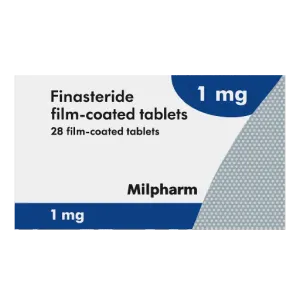

What are finasteride 1mg tablets?
Finasteride 1mg is a prescription-only medicine licensed in the UK for male pattern hair loss, also called androgenetic alopecia, in men. It can help slow further loss and may increase hair growth.3
We supply generic finasteride 1mg tablets. Propecia is a brand name for a medicine containing finasteride 1mg. Generic products contain the same active ingredient and strength, but the manufacturer, appearance, inactive ingredients and packaging may differ. Branded Propecia is not guaranteed on this page. If you specifically want the branded medicine, view our Propecia tablets.
Does finasteride 1mg work for hair loss?
The main job of finasteride is to hold on to the hair you still have, and a good number of men see some regrowth on top of that. It doesn't work for everyone, it can't revive follicles that have already gone, and how much difference it makes varies a lot from man to man, which is why starting sooner usually means there is more to protect.
Here's the research that conclusion is built on, and what each study can and can't tell you.
| Research | What was studied | Main finding | Important limitation |
|---|---|---|---|
| Kaufman and colleagues, 199812 | 1,553 men aged 18 to 41 received finasteride 1mg or placebo; 1,215 continued into year two | The finasteride–placebo difference was 107 hairs at year one and 138 at year two in a marked 5.1cm² vertex area | These are target-area counts, not whole-scalp new hairs; participants were selected younger men and the study had industry involvement |
| Five-year extension, 200213 | Men from the pivotal programme continued treatment for up to five years | 48% of the 290 men who completed five years were rated improved on standardised photographs | The five-year analysis included 290 finasteride and 16 placebo completers, far fewer than entered the original trials |
| Mella and colleagues, 201014 | A systematic review of 12 trials involving 3,927 men | Moderate-quality evidence supported improved patient assessment and hair-count outcomes at shorter and longer follow-up | Studies used different outcomes and follow-up periods; the review also found an increased risk of erectile dysfunction |
If you do start, photographs taken under similar lighting and from the same angles make it much easier to judge any changes in your hair.
Does finasteride work on a receding hairline?
Most of the published hair counts for finasteride 1mg come from a marked area at the vertex, which is the crown towards the back of the head. That is where the measured evidence is strongest.12 UK professional information also reports improvement in the frontal area, meaning the thinning strip that sits behind the hairline rather than the hairline itself.3
The temples are the weakest part of the picture. Recession at the corners of the hairline is the least studied area and tends to respond least.9
That does not make finasteride pointless if your hairline is the thing bothering you. Finasteride cannot bring back a follicle that has stopped producing hair. The sooner you start treatment, the better your chances of maintaining existing hair and achieving regrowth.
How does finasteride work for hair loss?
An enzyme called type II 5-alpha reductase converts some testosterone into dihydrotestosterone, or DHT. In genetically susceptible scalp follicles, DHT contributes to progressive miniaturisation, so hairs become shorter and finer over time.3
Finasteride inhibits type II 5-alpha reductase and reduces scalp and blood DHT. That can slow the miniaturisation process while treatment continues. The percentage reduction in DHT is not a percentage success rate, and it cannot predict how much hair an individual will retain or grow.3
Buy finasteride online in the UK
Finasteride 1mg tablets start at £10.99 for 28 tablets, which is just 39p a day, and the price covers everything: the online consultation, the private prescription, and discreet UK delivery. There is no separate prescription fee and no membership to join. Larger packs bring the daily cost down to 26p, and a subscription takes another 10% off and arrives automatically so you don't run out mid-course.
Hair loss treatment is not usually funded on the NHS, because pattern hair loss is treated as a cosmetic problem rather than a medical one. Paying privately is the normal route for finasteride 1mg in the UK, which is why the price above covers the whole service rather than the tablets alone.
Finasteride is a prescription-only medicine, so we can't sell it over the counter. Here's what happens instead:
- Choose your pack and answer the consultation. It takes two or three minutes. Be straight with the answers, particularly on mood, sexual function and any other medicines, because that is what the prescriber is reading.
- Our prescriber reviews it. They look at your pattern of hair loss, your health and your medicines, and decide whether finasteride 1mg is appropriate for you.
- We dispense and send it. Orders approved before 3pm are dispatched the same working day, in plain packaging with nothing on the outside to say what is inside.
Not every consultation ends in a prescription. Our prescriber may come back with questions, suggest a different treatment, or decide finasteride isn't safe for you. If treatment isn't approved, the pending charge on your card is cancelled and you are refunded in full. You are never charged for a medicine you don't receive.
Who can use our finasteride service?
This service is for men aged 18 or over with gradual male pattern hair loss, such as recession at the temples or thinning over the crown. Sudden, patchy, painful, inflamed or scarring loss may have another cause and needs a different assessment.9
This service may be suitable if
- You are an adult man with gradual, pattern-type hair loss.
- Your scalp otherwise appears healthy.
- You understand that continued treatment is usually needed to maintain benefit.
- You will take the medicine exactly as prescribed and attend follow-up when requested.
Do not use this service if
- You are allergic to finasteride or another ingredient in the tablets.
- You are a woman or are under 18; this medicine is not indicated for women or children and our service is for adult men.
Tell our prescriber before treatment if you have experienced depression, suicidal thoughts, sexual symptoms, fertility problems, liver problems or prostate or urinary symptoms; if you are having a PSA test; or if you use any medicine or supplement. Also disclose finasteride 5mg, dutasteride or any topical product containing finasteride so treatment is not duplicated.
Finasteride results: when can changes appear?
Don't expect changes overnight as your hair doesn't grow that fast. Expect to give it around 3 to 6 months before you notice things settling down, and 6 to 12 months before judging whether it's working for you. The early months are the ones men most often give up in, and that's the part worth sticking with.3
- First 3 months: too early to see a difference. Nothing visible yet does not mean it isn't working.
- Around 3 to 6 months: this is usually when men first notice hair coming out less than it was.
- Around 6 to 12 months: You should start seeing a reduction in hair loss and a possible increase in hair thickness, diameter, and overall coverage.
Benefit depends on continued treatment. UK professional information says beneficial effects begin to reverse by about six months after stopping and return towards baseline by 9 to 12 months. Message our prescriber if you plan to stop.3
We highly suggest you take pictures before starting treatment and then take them monthly during treatment to assess your response. Take them in the same lighting, from multiple angles and with roughly the same hair length. Judging results by eye can be hard due to how long the treatment takes to work.
Does finasteride cause shedding?
Some men notice more loose hairs than usual in the first weeks or months of treatment. It's talked about a lot online, where it's often called a shed or shedding phase. It is not listed as a side effect in the UK leaflet for finasteride 1mg, and there is no trial evidence that it happens because of finasteride or that it predicts how well you'll respond.3
Increased shedding is better understood with minoxidil, which can push resting hairs out early so a new growth cycle can begin. If you started minoxidil at the same time as finasteride, that is the more likely explanation.
Everyone loses some hair daily, and it is normal for that amount to vary. A modest, short-lived increase early on is not a reason to panic, but it is also not proof that treatment is working and should not be a reason to ignore a change that looks different from your usual pattern.
Ask our pharmacy team for advice if hair loss is sudden or heavy, comes out in patches, affects your beard, eyebrows or body hair, or comes with an itchy, painful, red, scaly or scarred scalp. These are not features of male pattern hair loss and may point to another cause that needs assessing.9
How to take finasteride 1mg
If approved, take one 1mg tablet once daily, following the pharmacy label and the instructions supplied with your pack.
- Swallow the tablet whole with water, with or without food.
- Take it at a time you can remember consistently.
- If you forget a dose, do not take a double dose; continue with the next dose as directed in your leaflet.
- Do not take more than 1mg daily for hair loss or use somebody else's tablets.
- Do not split or crush 5mg tablets as a substitute for the prescribed 1mg product.
Always read the patient information leaflet supplied with the exact manufacturer's pack because appearance and inactive ingredients can vary.
Side effects of finasteride
The current UK leaflet classifies reduced interest in sex, difficulty getting or maintaining an erection and ejaculation changes as uncommon. In the first year of the clinical programme reported in UK professional information, one or more drug-related sexual effects were reported by 3.8% taking finasteride and 2.1% taking placebo. Individual events included reduced libido (1.8% versus 1.3%), erectile dysfunction (1.3% versus 0.7%) and reduced ejaculate volume (0.8% versus 0.4%).3
A meta-analysis of double-blind placebo-controlled trials found an increased relative risk of sexual dysfunction with finasteride 1mg, but those trials assessed events during treatment and do not measure how often symptoms persist after stopping.15
Sexual symptoms may resolve or persist after stopping. UK professional information says these effects resolved in men who stopped treatment and in many who continued. Among men followed for longer, the overall incidence decreased to 0.6% over the following four years, and by year five each of the individual effects was reported by fewer than 0.3%. Persistent sexual dysfunction after stopping has also been reported, and its frequency cannot be estimated.34
- Ask our pharmacy team for advice if sexual symptoms occur or concern you.
- Report a breast lump, nipple discharge, tenderness, enlargement or another breast change promptly. Breast tenderness and enlargement have been reported with finasteride, and so has breast cancer in men. The frequency of these reports cannot be estimated from the available data, which is why any breast change should be checked rather than watched.3
- Seek urgent medical help for swelling of the lips, face, tongue or throat, marked difficulty breathing or another severe allergic reaction.
Suspected side effects can be reported through the MHRA Yellow Card scheme.
Mental health and sexual function: current MHRA advice
The MHRA updated its advice in May 2026 after reviewing psychiatric and sexual side effects with finasteride and dutasteride. Tell our prescriber if you have a history of depression, suicidal thoughts or troublesome sexual symptoms before starting treatment.4
Stop finasteride 1mg and contact our prescriber as soon as possible if you develop depression or suicidal thoughts. If you feel at immediate risk of harming yourself or somebody else, call 999 or go to A&E. For other urgent mental health advice, contact NHS 111. You can also call Samaritans on 116 123 for someone to talk to.4
Ask our pharmacy team for advice if sexual dysfunction develops. Sexual dysfunction that continued after stopping finasteride has been reported, but its frequency cannot be estimated from the available data. Read and keep the current patient alert card and the leaflet supplied with your pack.4
Fertility, pregnancy handling, PSA tests and blood donation
Fertility and pregnancy
Poor semen quality and infertility have been reported in men taking finasteride, and improvement after stopping has also been reported. Long-term fertility data are limited. Tell our prescriber if you are trying to conceive or have fertility concerns.3
The NHS says only a very small amount of finasteride, less than 0.001% of a dose, has been detected in semen and harm to a developing male baby from exposure through semen is very unlikely. Having a pregnant partner is therefore not automatically a reason a man cannot use finasteride, but follow the advice from our prescriber.7
Women who are pregnant or may become pregnant must not handle crushed or broken tablets because finasteride can be absorbed through the skin. The coating on an intact tablet prevents normal contact with the active ingredient. If contact with a broken tablet occurs, wash the area and seek advice.3
PSA blood tests
Finasteride lowers prostate-specific antigen, or PSA, and in men taking it a PSA result is roughly halved. A figure that looks reassuring may therefore understate the true level, which matters if you are being checked for a prostate problem. Always tell the clinician arranging or interpreting a PSA test that you take finasteride so they can allow for it. Do not adjust or interpret the result yourself.3
Blood donation
Do not donate blood while taking finasteride or for four weeks after the last dose, following UK donor guidance.10
Finasteride 1mg, 5mg, topical finasteride and Propecia: what is the difference?
| Product | Usual licensed use | What to know |
|---|---|---|
| Generic finasteride 1mg | Male pattern hair loss in men | The active ingredient and strength supplied on this page; manufacturer and appearance may vary |
| Propecia 1mg | Male pattern hair loss in men | A brand containing finasteride 1mg; it is not the product guaranteed on this generic page |
| Generic finasteride 5mg | Benign prostatic hyperplasia | Not the licensed hair-loss tablet and should not be split or self-dosed as a cheaper substitute |
| Topical finasteride | No UK marketing authorisation | Applied to the scalp rather than swallowed; any UK supply is unlicensed and the evidence base is much smaller than for the tablet |
Dose-ranging trials found 1mg and 5mg had similar hair-loss efficacy and selected 1mg as the optimal dose. Taking 5mg is not expected to improve the hair response and can increase medicine exposure.16 Use only the strength written on your prescription.
Can finasteride be used with minoxidil?
Finasteride reduces DHT, while minoxidil supports hair growth through a different mechanism that is not fully understood. For eligible men, we generally recommend considering both approaches because they address different parts of male pattern hair loss, but only after our prescriber confirms that each medicine is safe and suitable. Either treatment alone can remain appropriate.
A review of five randomised trials involving 456 patients found that finasteride combined with topical minoxidil performed better on some global photographic outcomes than either treatment alone. 17
Evidence for finasteride with oral minoxidil is more limited. A 2025 UK service evaluation reported 92.4% of 502 men as stable or improved after 12 months and 57.4% as improved. The study was retrospective and had no comparison group, so it cannot show whether the oral combination works better than either medicine alone.18
A separate 2015 study used oral finasteride with topical minoxidil. At 12 months, 94.1% of men on both medicines showed an improvement, compared with 80.5% taking finasteride alone and 59% using topical minoxidil alone. These figures should not be presented as results for oral minoxidil.21
For a topical minoxidil option, view our Regaine for Men Extra Strength Solution. Oral minoxidil for hair loss is prescribed off-label; view our oral minoxidil tablets page for its separate eligibility, monitoring and safety information.
How do finasteride and dutasteride compare for hair loss?
Finasteride 1mg is licensed in the UK for male pattern hair loss and mainly inhibits type II 5-alpha reductase. Dutasteride 0.5mg inhibits type I and type II enzymes and is prescribed off-label when used for hair loss.311
| Feature | Finasteride 1mg | Dutasteride 0.5mg |
|---|---|---|
| UK hair-loss licence | Licensed | Off-label |
| Enzyme action | Primarily type II 5-alpha reductase | Type I and type II 5-alpha reductase |
| Time to clear the body | Terminal half-life of about five to six hours in men aged 18 to 603 | Terminal half-life of about three to five weeks11 |
A 24-week trial of 917 men found dutasteride 0.5mg produced greater changes on several hair-count, width and photographic endpoints, but follow-up was short and the study included manufacturer employees.19 A network meta-analysis ranked dutasteride 0.5mg highest for 24-week total hair count, though many comparisons were indirect and no 48-week dutasteride hair-count evidence was available.20
The stronger short-term result does not make dutasteride the best choice for every person. Licensing, medical history, previous response, possible side effects and the longer time dutasteride remains in the body all matter. Use one DHT-reducing medicine; we do not recommend routinely taking finasteride and dutasteride together. Do not overlap or switch without instructions from our prescriber. See our dutasteride capsules page for more detail.
Support after you start
Finasteride is a long-term treatment, so placing the order is the start of it rather than the end. Our pharmacy team is here for the questions that come up months later, and asking costs nothing.
- If a side effect appears and you're weighing up whether to stop, message us before you do.
- If you're booked in for a PSA test, or your GP adds a new medicine, tell us so we can check it against your treatment.
- If you want to add minoxidil, move across to dutasteride, or come off treatment altogether, our prescriber will tell you how to do it properly rather than leaving you to work it out from a forum.
- If your hair loss changes character, becomes patchy, or your scalp becomes sore or inflamed, that needs looking at rather than waiting for your next order.
Finasteride FAQs
Can I buy finasteride without a prescription?
No. Finasteride is a prescription-only medicine in the UK. We can supply it only after our prescriber has assessed and approved your consultation.
Is finasteride available on the NHS?
Not usually. Pattern hair loss is generally treated as a cosmetic problem rather than a medical one, so NHS prescriptions for finasteride 1mg are uncommon and most men in the UK pay for treatment privately.
Is generic finasteride the same as Propecia?
Propecia is a brand containing finasteride 1mg. A generic contains the same active ingredient and strength, but the manufacturer, appearance and inactive ingredients may differ. Branded Propecia is not guaranteed on this page.
How long does finasteride take to work?
Stabilisation may become evident after around 3 to 6 months, but visible results are usually assessed over 6 to 12 months.
Does finasteride regrow hair?
It may increase hair growth and slow further loss. Trial hair counts came from small marked scalp areas, not the whole scalp.
Does finasteride work on the hairline and temples?
The measured evidence is strongest at the vertex, or crown, where the pivotal trials counted hairs. Improvement in the frontal area behind the hairline is also reported in UK professional information. Recession at the temples is the least studied area and tends to respond least, so expect less there than at the crown.
What happens if I stop taking finasteride?
Hair benefits begin to reverse after stopping. UK professional information says reversal begins by about six months and hair returns towards baseline by 9 to 12 months. Message our prescriber before stopping.
Is finasteride 5mg better than 1mg for hair loss?
No. Dose-ranging research found 1mg and 5mg similarly effective for hair loss and selected 1mg as the optimal dose. Finasteride 5mg is licensed for prostate enlargement, not as a stronger hair-loss dose.
Is topical finasteride an alternative to the tablets?
Topical finasteride is applied to the scalp instead of being swallowed, with the aim of reducing how much reaches the rest of the body. There is no licensed topical finasteride product in the UK, so any supply is unlicensed and the evidence base is much smaller than for the 1mg tablet. We supply the licensed tablet.1
Can women order finasteride?
No. We supply finasteride for hair loss only to suitable adult men. Women who are pregnant or may become pregnant must not handle crushed or broken tablets.
Does finasteride lower testosterone?
No. Finasteride blocks the conversion of testosterone into DHT rather than reducing testosterone itself, and serum testosterone tends to rise slightly while staying within the normal range. Sexual side effects, where they occur, are not explained by low testosterone.3
Can I drink alcohol while taking finasteride?
There is no known interaction between finasteride and alcohol, and you do not need to avoid drinking while taking it.
Can finasteride be taken with minoxidil?
They can be considered together because they work differently, but only after our prescriber confirms that each is safe and suitable for you. Evidence is stronger for combination with topical minoxidil than for oral minoxidil, and either medicine alone can remain appropriate.
Can finasteride be taken with dutasteride?
We do not recommend routinely taking them together. They both reduce DHT, so use one DHT-reducing medicine unless our prescriber gives specific instructions during a managed change. Do not overlap or switch them yourself.
Are sexual side effects permanent?
Sexual symptoms that continued after stopping have been reported, but the available data cannot estimate how often this happens. Ask our pharmacy team for advice if symptoms develop or continue. The clinical-trial meta-analysis measured events during treatment and cannot answer the persistence question.
Does finasteride affect fertility or a pregnant partner?
Poor semen quality and infertility have been reported, sometimes improving after stopping, but long-term data are limited. The amount detected in semen is very small and harm through semen is considered very unlikely. Tell our prescriber if you have fertility concerns or your partner is pregnant.
Does finasteride affect PSA tests?
Yes. It roughly halves PSA results, so a normal-looking figure can understate the true level. Tell the clinician arranging or interpreting the test that you take finasteride, and do not adjust the result yourself.
Can I donate blood while taking finasteride?
No. UK donor guidance requires you to wait until four weeks after your last dose before donating blood.
Clinical sources and further information
This page is a treatment overview and does not replace the leaflet supplied with your pack or individual advice from a prescriber.
Regulatory and clinical guidance
- eMC: finasteride medicine and manufacturer directory (accessed 19 August 2026)
- eMC: current example finasteride 1mg patient leaflet (accessed 19 August 2026)
- eMC: current example finasteride 1mg professional information (accessed 19 August 2026)
- MHRA: May 2026 finasteride and dutasteride safety update (accessed 19 August 2026)
- MHRA: Yellow Card scheme for reporting side effects (accessed 19 August 2026)
- NHS: about finasteride (accessed 19 August 2026)
- NHS: fertility and pregnancy while taking finasteride (accessed 19 August 2026)
- NHS: hair loss (accessed 19 August 2026)
- British Association of Dermatologists: male pattern hair loss (accessed 19 August 2026)
- JPAC: UK blood-donation guidance (accessed 19 August 2026)
- eMC: current example dutasteride 0.5mg professional information (accessed 19 August 2026)
Published studies
- 1998 pivotal randomised finasteride 1mg trials (accessed 19 August 2026)
- 2002 five-year finasteride extension study (accessed 19 August 2026)
- 2010 systematic review of finasteride for male pattern hair loss (accessed 19 August 2026)
- 2019 meta-analysis of sexual adverse effects in hair-loss trials (accessed 19 August 2026)
- 1999 finasteride dose-ranging studies (accessed 19 August 2026)
- 2020 review of finasteride combined with topical minoxidil (accessed 19 August 2026)
- 2025 UK service evaluation of oral minoxidil with finasteride (accessed 19 August 2026)
- 2014 randomised dutasteride dose and finasteride comparison (accessed 19 August 2026)
- 2022 network meta-analysis of hair-loss medicines (accessed 19 August 2026)
- 2015 Combined treatment with oral finasteride and topical minoxidil in male androgenetic alopecia: a randomized and comparative study in Chinese patients (accessed 21 August 2026)