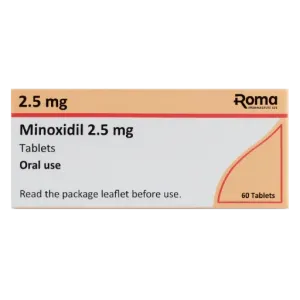

What are oral minoxidil 2.5mg tablets?
Oral minoxidil is a prescription-only tablet that may be prescribed to suitable adult men and women with pattern hair loss, also called androgenetic alopecia. It may help slow further thinning and support hair growth, although results vary.9
We supply 2.5mg tablets only. If our prescriber approves treatment, the directions through this service are:
Men: Take ONE tablet daily.
Women: Take HALF a tablet daily.
Follow your pharmacy label and do not change your prescribed dose without advice from the prescriber.
Minoxidil tablets are licensed in the UK for severe high blood pressure rather than hair loss, so using them for hair loss is off-label. That means a qualified prescriber has to decide treatment is clinically appropriate after weighing the evidence, the expected benefit and the risks. It is a normal part of UK prescribing, not a loophole, and it is why supply here depends on an individual assessment rather than a click. Certain topical minoxidil products are separately licensed for pattern hair loss.27
Do oral minoxidil 2.5mg tablets work?
Minoxidil does not block DHT, so it is not treating the cause of male pattern hair loss. What it does is keep follicles in their growing phase for longer, which for many men means thicker, denser hair while the underlying process carries on beneath it. That is the reason it is often prescribed alongside finasteride or dutasteride rather than on its own, and the reason any gain depends on continuing to take it.9
The evidence base is younger than finasteride's. Trials use different doses and outcome measures, longer-term controlled research is still limited, and there is no reliable success percentage that applies to every man on 2.5mg. Here is what the studies show and what each one cannot tell you.
| Research | What was studied | Main finding | Important limitation |
|---|---|---|---|
| 2.5mg versus 5mg randomised trial10 | 100 men treated for 24 weeks | 5mg was not superior to 2.5mg on the measured hair-density outcomes; dizziness and ankle swelling were more frequent with 5mg | Single-centre study with 24-week follow-up |
| Oral versus topical meta-analysis12 | Four randomised trials involving 279 people | No significant overall difference in hair density or diameter; unwanted face or body hair was more frequent with oral treatment | Small trials using different oral doses and different participants |
| Oral 5mg versus topical 5% trial11 | 90 men treated for 24 weeks | Oral 5mg did not show overall superiority to topical 5% | The oral dose was 5mg, not the 2.5mg dose we supply |
| 1,404-patient safety study13 | People with different hair-loss diagnoses receiving varied low doses | Unwanted hair growth was the most frequently reported effect; systemic effects were less frequent | Retrospective and uncontrolled, and not a 2.5mg efficacy trial |
Your response also depends on the cause, severity and duration of your hair loss. Photographs taken every few months in similar lighting and from the same angles are far more useful than checking your hair every day.
Does oral minoxidil work on a receding hairline?
Minoxidil acts on the hair-growth cycle rather than on how sensitive a follicle is to DHT, so it is not tied to one region of the scalp in the way the DHT story is. Trial measurements were still taken from defined target areas, so treat any claim about a specific patch of scalp with caution.9
Response varies with the extent and duration of hair loss, and a lost hairline may not return. Maintaining existing hair can be a useful result in itself. Your prescriber can help set realistic expectations for the pattern of hair loss you have.6
How does oral minoxidil work for hair loss?
The precise way minoxidil supports hair growth is not fully understood. It is thought to act on hair follicles and the growth cycle, helping some follicles stay in their active growing phase for longer.9
Minoxidil does not reduce dihydrotestosterone, or DHT. Its action is therefore different from finasteride and dutasteride, which reduce how much DHT is formed. That difference is why a prescriber may consider using minoxidil alongside one of them for suitable men.
Buy oral minoxidil online in the UK
Oral minoxidil 2.5mg tablets start at £15.00 for 30 tablets, which is 50p a day at one tablet daily, and the price covers the online consultation, the private prescription and discreet UK delivery. There is no separate prescription fee and no membership to join. At one tablet daily, larger packs bring the daily cost down to around 42p, and a subscription takes another 10% off and arrives automatically so you do not run out mid-course. At the prescribed half-tablet daily dose for women, 30 tablets provide 60 days of treatment.
Hair loss treatment is not usually funded on the NHS, because pattern hair loss is treated as a cosmetic problem rather than a medical one. Oral minoxidil is off-label for hair loss as well, so an NHS prescription for it is very unlikely and paying privately is the normal route.
Minoxidil tablets are prescription-only, so we cannot sell them over the counter. Here is what happens instead:
- Choose your pack and answer the consultation. Be accurate about your heart, blood pressure, kidney health and every medicine you take, because that is the part the prescriber is weighing up.
- Our prescriber reviews it. They look at your pattern of hair loss, your cardiovascular history and your medicines, and decide whether oral minoxidil is appropriate for you off-label.
- We dispense and send it. Orders approved before 3pm are dispatched the same working day, in plain packaging with nothing on the outside to say what is inside.
Not every consultation ends in a prescription. Our prescriber may come back with questions, ask for a blood-pressure reading, suggest a different treatment, or decide oral minoxidil is not safe for you. If treatment is not approved, the pending charge on your card is cancelled and you are refunded in full. You are never charged for a medicine you do not receive.
Who can use our oral minoxidil service?
This service is for adult men and women with gradual, pattern-type hair loss. In men this may include thinning at the temples, a receding hairline or thinning around the crown; women may notice thinning over the top of the scalp or a widening parting. Our prescriber reviews your answers before deciding whether treatment is suitable.
This service may be suitable if
- You are an adult with gradual, pattern-type hair loss.
- Your scalp otherwise appears healthy.
- You understand that results are not guaranteed and treatment needs consistent use.
- You will follow any blood-pressure, pulse or follow-up advice from the prescriber.
Tell our prescriber before treatment if
- You have heart disease, chest pain, palpitations, fainting or another cardiovascular condition.
- You have low blood pressure, kidney problems or a history of fluid retention.
- You take medicines that lower blood pressure or affect your heart rate.
- Your hair loss is sudden, patchy, unexplained, inflamed or associated with scarring.
Women can use this service after an individual prescriber assessment. If treatment is approved, the directions are Take HALF a tablet daily. Half of a 2.5mg tablet provides 1.25mg. Follow your pharmacy label and the monitoring advice you are given.
Do not use oral minoxidil for hair loss if you are pregnant, trying to conceive or breastfeeding.9 If you could become pregnant, discuss contraception with your prescriber.2
Sudden, patchy or unexplained hair loss can have causes that need a different assessment. See a GP before using a commercial hair-loss service if you are unsure what is causing it, and read the NHS guidance on hair loss.
Oral minoxidil results: when can changes appear?
Hair grows slowly, so this needs time and consistent use. The early weeks often look worse before they look better, which catches people out.
- First 4 to 6 weeks: some people notice temporary increased shedding; others do not. See the section below for advice.
- Around 3 to 6 months: the point where early changes usually start to become visible and the response can begin to be judged.
- Around 6 to 12 months: a useful time to review any change in hair thickness and coverage. Improvement is not guaranteed.
Any benefit is generally maintained only while treatment continues. Message our prescriber if you are thinking of stopping.6
Does oral minoxidil cause shedding?
Some people notice a temporary increase in shedding when starting minoxidil. It can happen as the hair-growth cycle changes, but it does not affect everyone.5
Early shedding usually settles within about six weeks. It does not prove that treatment is working or failing. Contact our pharmacy team if you are worried, so the prescriber can assess the change and advise you about continuing.
Take your baseline photographs before you start the first tablet. Once a shed is under way it becomes very hard to judge whether you are ahead or behind without something to compare against.
Ask our pharmacy team for advice if shedding is severe, persists beyond the first few weeks, comes out in patches, affects your beard, eyebrows or body hair, or comes with an itchy, painful, red, scaly or scarred scalp. Those are not features of pattern hair loss and may point to another cause that needs assessing.3
How to take oral minoxidil 2.5mg tablets
If treatment is approved, follow the directions for your prescribed dose:
Men: Take ONE tablet daily.
Women: Take HALF a tablet daily.
We supply 2.5mg tablets, so half a tablet provides 1.25mg. Try to take your dose at roughly the same time each day.
- Take your prescribed dose with water.
- Do not take more than prescribed if your hair has not improved yet.
- Follow the dose on your pharmacy label.
- If you miss a dose and it is nearly time for the next one, skip the missed dose. Do not take two doses together.
Always read the patient information leaflet supplied with your particular pack.
Assessment and monitoring
Minoxidil was developed as a blood-pressure medicine, so cardiovascular safety is a real part of prescribing it for hair loss rather than a formality. Your consultation needs accurate information about your health, your medicines and any history of low blood pressure, palpitations, fainting, heart disease, kidney problems or fluid retention.9
Oral minoxidil may be unsuitable, or need further assessment, if you have a relevant heart or kidney condition, very low blood pressure, phaeochromocytoma, a previous serious reaction to minoxidil, or take medicines that lower blood pressure.2
It is recommended to have blood-pressure and pulse readings before starting treatment and monitoring your blood pressure throughout. Follow the monitoring plan you are given, and report new symptoms rather than changing the dose yourself.9
Side effects of oral minoxidil
Not everyone gets side effects. How likely they are varies with dose and individual health, and research using other doses cannot precisely predict your own risk.13
Reported side effects
- Increased facial or body hair.
- Headache, light-headedness or dizziness.
- A faster heartbeat or palpitations.
- Ankle, leg or facial swelling caused by fluid retention.
- Nausea, skin rash or temporary increased scalp-hair shedding.
Ask our pharmacy team for advice if you develop persistent dizziness, new palpitations, swelling around your ankles or face, unexpected weight gain, a troublesome rash or another symptom that concerns you.
Seek urgent medical help if you experience chest pain, significant difficulty breathing, fainting or signs of a serious allergic reaction. Call 999 for severe or life-threatening symptoms rather than waiting for an online reply.
Suspected side effects can be reported through the MHRA Yellow Card scheme.
Unwanted hair growth on the face and body
This is the effect people on oral minoxidil report most often.13
Minoxidil works on hair follicles wherever they happen to be, not only the ones on your scalp. Extra growth typically shows up on the cheeks, above the eyebrows, on the forearms and on the upper back. It tends to be finer than normal body hair and it can be dose-related, which is part of why this service supplies 2.5mg rather than a higher strength. In the trial in men comparing 2.5mg with 5mg, the higher dose brought more side effects without better hair-density results.10
It reverses after stopping, but slowly, over months rather than weeks, as the hair has to complete its own cycle.
Oral minoxidil, other medicines and alcohol
Tell our prescriber about every prescription medicine, over-the-counter treatment, supplement and herbal remedy you use. This matters most for medicines used to treat high blood pressure or heart conditions, diuretics, and anything else that can lower blood pressure.2
Alcohol can lower blood pressure and may make dizziness or light-headedness more likely. Limit or avoid it until you know how treatment affects you, and follow your prescriber's advice. Do not drive, cycle or operate machinery if you feel dizzy or faint.5
Oral minoxidil versus topical minoxidil
Both may be considered for pattern hair loss, and they differ in licensing, convenience and side effects. Oral minoxidil has not been shown to be better overall than topical treatment, so the choice is usually about what you will actually stick to.1112
| Feature | Oral minoxidil | Topical minoxidil |
|---|---|---|
| How it is used | Men: Take ONE tablet daily. Women: Take HALF a tablet daily. | Liquid or foam applied to the scalp as directed |
| UK licensing | Prescription-only; use for hair loss is off-label | Certain products are licensed for pattern hair loss and sold without a prescription |
| Practical differences | No scalp application, residue or drying time | Avoids taking a systemic medicine, but needs regular application as directed for as long as you want the benefit |
| Possible drawbacks | Can affect blood pressure, heart rate and fluid balance, and can increase facial or body hair | Can cause scalp irritation, dryness, itching or residue |
| Price from | £15.00 for 30 tablets | £27.99 for one 60ml bottle of Regaine 5% solution |
Current randomised evidence has not established clear overall superiority for the oral route. For men considering a licensed topical option, view our Regaine for Men Extra Strength 5% Solution.
Can oral minoxidil be taken with finasteride or dutasteride?
Yes, if our prescriber confirms each medicine is safe and suitable for you. For eligible men with male pattern hair loss, we generally recommend considering oral minoxidil alongside one DHT-reducing medicine, either finasteride or dutasteride.
As Minoxidil grows hair but does not touch DHT the androgen-driven miniaturisation carries on underneath. Finasteride or dutasteride slows that process down but does not push follicles to grow. Using both covers more of the problem than either does alone. Minoxidil on its own can still be the right answer, particularly if a DHT-reducing medicine is unsuitable for you or you would rather not take one.
What the research shows
- A 2025 retrospective evaluation of 502 men taking oral minoxidil 2.5mg with finasteride 1mg found 92.4% had stable or improved photographic outcomes after 12 months, and 57.4% improved. It had no minoxidil-only comparison group and did not systematically collect side-effect data, so it cannot prove the oral combination is superior.14
- A systematic review of five randomised trials found better overall photographic outcomes with finasteride plus minoxidil than with either alone. The minoxidil in those trials was topical rather than oral.15
- A 2025 comparison of low-dose oral minoxidil alone against minoxidil with finasteride or dutasteride reported better outcomes for the combinations, but it was not a randomised trial.16
- A 2025 retrospective study of oral minoxidil with oral dutasteride reported better photographic outcomes at six months than oral minoxidil alone. The groups were not randomised and received different average minoxidil doses, so it does not prove dutasteride caused the difference.17
Taken together, the research supports pairing a growth-promoting treatment with a DHT-reducing one for suitable men, but the direct evidence for the oral combinations is observational and does not prove combination treatment is best for everyone.
For suitable men, use minoxidil with either finasteride or dutasteride, not finasteride and dutasteride together. Do not start, stop or combine these medicines until our prescriber has assessed the expected benefit, contraindications and possible side effects for you.
Support after you start
Oral minoxidil is a long-term, off-label treatment with a medicine that affects blood pressure, so the order is the start of it rather than the end. Our pharmacy team is here for the questions that come up later, and asking costs nothing.
- If early shedding worries you, contact our pharmacy team. The prescriber can help assess it and discuss whether to continue treatment.
- If you notice swelling, palpitations or persistent dizziness, tell us rather than waiting for your next order.
- If your GP starts a blood-pressure medicine or a diuretic, let us know so we can check it against your treatment.
- If you want to come off treatment, or are a man considering adding finasteride or dutasteride, our prescriber will tell you how rather than leaving you to work it out from a forum.
Oral minoxidil FAQs
Can I buy minoxidil tablets without a prescription?
No. Oral minoxidil is a prescription-only medicine in the UK. Our prescriber must assess whether it is suitable before we can supply it.
Is oral minoxidil available on the NHS for hair loss?
Very unlikely. Pattern hair loss is generally treated as a cosmetic problem rather than a medical one, and oral minoxidil is off-label for it, so people in the UK normally pay for treatment privately. Some NHS dermatology services do prescribe it for other hair-loss diagnoses.4
Why is oral minoxidil prescribed off-label?
Minoxidil tablets are licensed for severe high blood pressure, not hair loss. A qualified prescriber can prescribe off-label when they judge it clinically appropriate after weighing the evidence, expected benefit and risks.
What dose do you prescribe?
We supply 2.5mg tablets. If treatment is approved, the directions are:
Men: Take ONE tablet daily.
Women: Take HALF a tablet daily.Follow your pharmacy label and do not change your prescribed dose without advice from the prescriber.
Can women order oral minoxidil?
Yes. Adult women with pattern hair loss can complete our consultation for an individual prescriber assessment. If treatment is approved, the directions are Take HALF a tablet daily. We supply 2.5mg tablets, so half a tablet provides 1.25mg. Oral minoxidil is not suitable during pregnancy, while trying to conceive or when breastfeeding.
How long does oral minoxidil take to work?
Some people notice changes after around 3 to 6 months, and a clearer assessment usually takes 6 to 12 months. Some people notice temporary shedding early on, but this is not a necessary sign of a response.
Does oral minoxidil cause shedding?
It can happen, but not everyone experiences it. Early shedding usually settles within about six weeks. Contact our pharmacy team if it is heavy, persists, or comes with scalp symptoms.
Will oral minoxidil give me facial or body hair?
It is the most frequently reported effect. Minoxidil acts on follicles wherever they are, so extra growth can appear on the cheeks, above the eyebrows, on the forearms and on the upper back. It is dose-related, which is why following the prescribed dose matters, and it reverses after stopping over months rather than weeks.
Does oral minoxidil work on the hairline and temples?
It may help some men, but a receding hairline is not guaranteed to regrow. The pattern, extent and duration of hair loss matter. Your prescriber can assess whether treatment is suitable and what changes are realistic.
Are minoxidil tablets better than topical minoxidil?
Not for everyone. Randomised studies have not established that the oral route is clearly better overall. Tablets may suit people who find regular scalp application difficult, while certain topical products are licensed for hair loss and involve less systemic exposure.
What happens if I stop taking oral minoxidil?
Any benefit is generally maintained only while you keep taking it. After stopping, hair loss gradually returns towards the course it would otherwise have followed. Message our prescriber before stopping.
Can I take oral minoxidil with finasteride or dutasteride?
Yes, if our prescriber confirms both medicines are suitable. For eligible men we generally recommend considering oral minoxidil with one DHT-reducing medicine, either finasteride or dutasteride, because they address different parts of male pattern hair loss. Direct evidence for the oral combinations is observational and does not prove it is best for everyone. Do not take finasteride and dutasteride together, or add any treatment, without individual clinical advice.
Can oral minoxidil lower blood pressure?
Yes. Minoxidil can lower blood pressure and may cause dizziness, faintness, palpitations or fluid retention. That is why your cardiovascular history, current medicines and any requested blood-pressure or pulse readings matter.
Can I drink alcohol while taking oral minoxidil?
Alcohol can lower blood pressure and may worsen dizziness or light-headedness. Limit or avoid it until you know how minoxidil affects you, and follow your prescriber's advice.
What should I do if I miss a dose?
Take the missed dose when you remember unless it is nearly time for the next one. If it is, skip it and continue normally. Do not take two doses together.
Clinical sources and further information
This page is a treatment overview and does not replace the leaflet supplied with your pack or individual advice from a prescriber.
Regulatory and clinical guidance
- eMC: minoxidil medicine and manufacturer directory (accessed 20 August 2026)
- eMC: minoxidil 2.5mg tablets professional information (accessed 20 August 2026)
- NHS: hair loss (accessed 20 August 2026)
- Northern Care Alliance NHS: low-dose oral minoxidil for hair loss (accessed 20 August 2026)
- Gloucestershire Hospitals NHS: minoxidil for hair loss (accessed 20 August 2026)
- British Association of Dermatologists: male pattern hair loss (accessed 20 August 2026)
- MHRA: off-label or unlicensed use of medicines and prescribers' responsibilities (accessed 20 August 2026)
- MHRA: Yellow Card scheme for reporting side effects (accessed 20 August 2026)
Published studies
- 2025 international expert consensus on low-dose oral minoxidil initiation and monitoring (accessed 20 August 2026)
- 2026 randomised trial comparing oral minoxidil 2.5mg and 5mg in men (accessed 20 August 2026)
- 2024 randomised trial of oral 5mg versus topical 5% minoxidil in men (accessed 20 August 2026)
- 2025 meta-analysis of randomised oral-versus-topical minoxidil trials (accessed 20 August 2026)
- Multicentre safety study involving 1,404 low-dose oral minoxidil patients (accessed 20 August 2026)
- 2025 oral minoxidil 2.5mg and finasteride 1mg service evaluation (accessed 20 August 2026)
- 2020 systematic review of finasteride and topical minoxidil combination trials (accessed 20 August 2026)
- 2025 comparison of low-dose oral minoxidil alone and with finasteride or dutasteride (accessed 20 August 2026)
- 2025 real-world oral minoxidil and oral dutasteride study (accessed 20 August 2026)