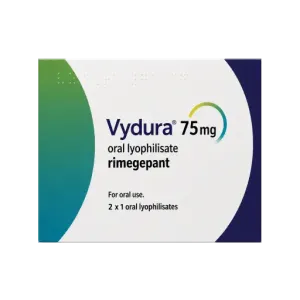

What is Vydura 75mg?
Vydura 75mg is a prescription migraine medicine containing the active ingredient rimegepant. It belongs to a group of medicines called calcitonin gene-related peptide receptor antagonists, also known as CGRP receptor antagonists or gepants.
Vydura can be used by adults to treat a migraine attack with or without aura. It can also be prescribed to help prevent episodic migraine in adults who experience at least four migraine attacks each month.
Vydura is supplied as an oral lyophilisate. This is a fast-dissolving, tablet-like medicine that is placed on or under the tongue and allowed to dissolve. It can be taken without water.
How to buy Vydura 75mg online
Vydura is a prescription-only medicine. You can request Vydura online from Hightown Pharmacy by completing a short migraine consultation.
Your answers will be reviewed by an independent prescriber, who will assess whether Vydura is suitable for you. If your treatment is approved, a prescription will be issued and the medicine will be dispensed by our UK-registered pharmacy.
Completing the consultation does not guarantee that Vydura will be prescribed. The prescriber may recommend a different treatment or ask for further information where necessary.
What is Vydura used for?
Vydura has two licensed uses in adults:
- Acute migraine treatment: treating a migraine attack once it occurs, whether the migraine is with or without aura.
- Migraine prevention: reducing the frequency of episodic migraine in adults who experience at least four migraine attacks per month.
The dose and treatment schedule are different depending on whether Vydura has been prescribed for acute treatment or prevention. Always follow the instructions provided by your prescriber.
How does Vydura work?
Calcitonin gene-related peptide, or CGRP, is a chemical messenger involved in migraine pain signalling. CGRP levels can increase during a migraine attack and contribute to pain and other migraine symptoms.
Rimegepant selectively blocks CGRP receptors. This reduces the effect of CGRP and can help relieve a migraine attack. When taken regularly every other day, it can also help reduce the frequency of migraine attacks.
Vydura is a gepant rather than a triptan. It therefore works differently from treatments such as sumatriptan, rizatriptan and zolmitriptan.
How to take Vydura for an acute migraine
The recommended dose for treating an acute migraine attack is one 75 mg oral lyophilisate when required.
- Take one 75 mg oral lyophilisate when you need to treat a migraine attack.
- Do not take more than one Vydura oral lyophilisate in any 24-hour period.
- If the first dose does not relieve your migraine, do not take a second Vydura dose on the same day.
- Follow the rescue-treatment plan agreed with your prescriber if your symptoms do not improve.
Vydura can be taken with or without food.
How to take Vydura for migraine prevention
The recommended dose for preventing episodic migraine is one 75 mg oral lyophilisate every other day.
- Take one oral lyophilisate every other day as directed by your prescriber.
- Do not take more than one Vydura oral lyophilisate in any 24-hour period.
- Do not change your dosing schedule without speaking to your prescriber.
- Ask your prescriber what to do if you experience a breakthrough migraine while using Vydura preventively.
Keeping a migraine diary can help you and your prescriber assess whether preventive treatment is reducing the frequency or severity of your migraine attacks.
How to use a Vydura oral lyophilisate
- Make sure your hands are completely dry before opening the blister.
- Only open the blister when you are ready to take the medicine.
- Carefully remove one oral lyophilisate from the blister.
- Place it on or under your tongue.
- Allow it to dissolve in your mouth.
Vydura does not need to be swallowed with water. Avoid handling the oral lyophilisate with wet hands because moisture may cause it to begin dissolving.
How quickly does Vydura work?
In clinical studies of acute migraine treatment, the main effects of Vydura were assessed two hours after taking a dose. Studies found that more people experienced pain relief, freedom from pain and relief from their most bothersome migraine symptom with Vydura than with a placebo.
Individual responses vary. Vydura may not completely relieve every migraine attack, and some people may respond more quickly or slowly than others.
If Vydura repeatedly fails to control your migraine attacks, speak to your prescriber rather than taking additional doses.
Vydura vs Sumatriptan
Vydura and sumatriptan are both prescription migraine treatments, but they belong to different groups of medicines.
- Vydura: contains rimegepant and belongs to the gepant group of medicines. It can be prescribed for acute migraine treatment or migraine prevention.
- Sumatriptan: belongs to the triptan group of medicines and is used to treat a migraine attack after it has started. It is not used as a daily preventive treatment.
The most suitable treatment will depend on your symptoms, other health conditions, medicines and response to previous migraine treatments. Do not combine or switch between Vydura and another prescription migraine medicine unless advised by your prescriber.
Who can take Vydura?
Vydura is licensed for adults aged 18 years and over. It may be prescribed for adults with an established history of migraine with or without aura.
Vydura is not suitable for treating every type of headache. New, unexplained or significantly changed headache symptoms should be medically assessed before treatment is started.
The safety and effectiveness of Vydura have not been established in people under 18 years of age.
Who should not take Vydura?
Do not take Vydura if you are allergic to rimegepant or any of the other ingredients in the medicine.
Tell your prescriber before taking Vydura if you:
- Have severe liver impairment
- Have end-stage kidney disease or receive dialysis
- Are pregnant, planning a pregnancy or think you may be pregnant
- Are breastfeeding
- Take prescription, non-prescription or herbal medicines
- Have previously experienced an allergic reaction to a gepant medicine
Vydura is not recommended for people with severe liver impairment or end-stage kidney disease.
Vydura interactions
Vydura can interact with medicines that affect the enzymes and transport proteins used to process rimegepant in the body. Some combinations should be avoided, while others require a longer interval between Vydura doses.
Tell your prescriber if you take any regular medication. Important examples include:
Medicines that may substantially increase rimegepant levels:
- Clarithromycin
- Itraconazole
- Ritonavir
Using Vydura with strong CYP3A4 inhibitors such as these is not recommended.
Medicines that may make Vydura less effective:
- Rifampicin
- Phenobarbital
- St John's wort
- Bosentan
- Efavirenz
- Modafinil
Using Vydura with strong or moderate CYP3A4-inducing medicines is not recommended. The interaction may continue for a period after the other medicine has been stopped.
Medicines that may require at least 48 hours between Vydura doses:
- Diltiazem
- Erythromycin
- Fluconazole
- Cyclosporine
- Verapamil
- Quinidine
This is not a complete list of interactions. Include all medicines, supplements and herbal remedies on your consultation form. Do not alter the timing of your prescribed medicines without professional advice.
Vydura side effects
Like all medicines, Vydura can cause side effects, although not everyone experiences them. The most commonly reported side effect is nausea.
Uncommon but potentially serious allergic reactions have also been reported. Symptoms can include:
- Difficulty breathing or shortness of breath
- Swelling of the face, lips, mouth, tongue or throat
- A severe or widespread skin rash
- Raised, itchy skin or hives
- Feeling faint or collapsing
Stop taking Vydura and seek urgent medical help if you develop signs of a serious allergic reaction.
An allergic reaction may occur immediately or several days after taking a dose. Seek advice even if some time has passed since you last took Vydura.
You can report suspected side effects through the MHRA Yellow Card Scheme.
Vydura and medication-overuse headache
Frequent use of medicines for acute headaches can sometimes make headaches more frequent or more difficult to treat. This is known as medication-overuse headache.
Speak to your prescriber if you develop frequent or daily headaches, find that you need acute migraine treatment increasingly often, or notice that your headaches are becoming more severe despite treatment.
Do not exceed the prescribed Vydura dose in an attempt to control frequent migraine attacks. Your treatment plan may need to be reviewed.
Vydura and pregnancy
There is limited information about the use of rimegepant during pregnancy. As a precaution, Vydura should generally be avoided during pregnancy.
Tell your prescriber if you are pregnant, planning a pregnancy or think you may be pregnant. Do not take Vydura during pregnancy unless a doctor has specifically advised that the potential benefit outweighs the possible risks.
Vydura and breastfeeding
A small study found that only minimal amounts of rimegepant passed into breast milk after a single 75 mg dose. However, information about repeated treatment and its effects on a breastfed baby remains limited.
Speak to your doctor or prescriber before taking Vydura while breastfeeding. They will consider the benefits of breastfeeding, your need for migraine treatment and any potential risk to your baby.
Vydura and driving
Vydura itself is not expected to have a significant effect on your ability to drive or use machinery. However, migraine symptoms such as visual disturbance, dizziness, nausea and difficulty concentrating can make driving unsafe.
Do not drive, cycle or operate machinery if your migraine or any suspected side effect affects your ability to do so safely.
What does Vydura contain?
Each Vydura oral lyophilisate contains rimegepant sulfate equivalent to 75 mg of rimegepant.
The other ingredients include:
- Gelatin
- Mannitol
- Mint flavour
- Sucralose
Check the patient information leaflet and speak to your pharmacist if you have an allergy, intolerance or dietary concern relating to any of the ingredients.
What is a migraine?
Migraine is a neurological condition that causes attacks of symptoms rather than simply an ordinary headache.
Common migraine symptoms include:
- A moderate or severe throbbing headache, often affecting one side of the head
- Pain that becomes worse with normal movement or activity
- Feeling or being sick
- Sensitivity to light
- Sensitivity to sound
Some people experience migraine with aura. Aura symptoms can include flashing lights, zigzag patterns, blind spots, tingling, numbness, dizziness or temporary difficulty speaking. Aura normally develops gradually and should not usually last longer than one hour.
When should I seek medical advice for migraine?
Arrange an appointment with your GP if:
- Your migraine attacks are severe, worsening or lasting longer than usual
- You experience migraine attacks more than once a week
- Your current treatment is no longer controlling your symptoms
- Your headache pattern has changed significantly
- You regularly experience migraine around your period
Contact NHS 111 or request an urgent GP appointment if a migraine attack lasts longer than 72 hours, aura symptoms last longer than one hour, or you are pregnant or have recently given birth.
Call 999 if you experience a headache that:
- Starts suddenly and is extremely painful
- Occurs with weakness or paralysis on one side of the face or body
- Occurs with problems speaking, remembering or understanding
- Occurs with loss of vision, blurred vision or double vision
- Occurs with confusion, severe drowsiness or a seizure
- Occurs with a very high temperature or symptoms of meningitis
- Develops after a recent head injury
Vydura alternatives
The most suitable migraine treatment depends on your symptoms, how often attacks occur, your previous treatment response and your other medical conditions.
Other prescription treatments for acute migraine include:
Do not take two different prescription migraine treatments together unless this has been specifically recommended by your prescriber.
How to store Vydura
- Store Vydura below 30°C.
- Keep each oral lyophilisate in its original blister until it is needed.
- Store the medicine in its original packaging to protect it from moisture.
- Keep Vydura out of the sight and reach of children.
- Do not use the medicine after the expiry date shown on the packaging.
Return unwanted or expired medicines to a pharmacy for safe disposal. Do not flush medicines down the toilet or dispose of them in wastewater.
More Vydura 75mg information
Always read the patient information leaflet supplied with your medicine before taking Vydura.
You can also view the official Vydura patient information leaflet and Vydura Summary of Product Characteristics .
Frequently asked questions
What is the active ingredient in Vydura?
Vydura contains rimegepant. Each oral lyophilisate contains 75 mg of rimegepant and is designed to dissolve on or under the tongue.
Is Vydura a triptan?
No. Vydura is a CGRP receptor antagonist, also known as a gepant. It works differently from triptan medicines such as sumatriptan, rizatriptan and zolmitriptan.
How many Vydura 75mg doses can I take in 24 hours?
Do not take more than one 75 mg Vydura oral lyophilisate in any 24-hour period. Do not take a second dose on the same day if the first dose does not relieve your migraine.
Can Vydura be used to prevent migraines?
Yes. Vydura is licensed to prevent episodic migraine in adults who experience at least four migraine attacks per month. The recommended preventive dose is one 75 mg oral lyophilisate every other day.
How do I take Vydura?
Use dry hands to remove the oral lyophilisate from its blister, place it on or under your tongue and allow it to dissolve. Vydura can be taken without water.
Can I take Vydura with food?
Yes. Vydura can be taken with or without food.
What should I do if Vydura does not relieve my migraine?
Do not take another Vydura dose on the same day. Follow the rescue-treatment plan agreed with your prescriber. Arrange a review if Vydura repeatedly fails to control your migraine attacks.
Can I take Vydura with Sumatriptan?
Do not combine Vydura with sumatriptan or another prescription migraine treatment unless your prescriber has specifically included both medicines in your treatment plan.
Can I take Vydura while pregnant?
Vydura should generally be avoided during pregnancy because information about its use in pregnant women is limited. Tell your prescriber if you are pregnant, planning a pregnancy or think you may be pregnant.
Can I take Vydura while breastfeeding?
Only minimal amounts of rimegepant were found in breast milk following a single dose in a small study, but information remains limited. Speak to your doctor or prescriber before taking Vydura while breastfeeding.
How should I store Vydura?
Store Vydura below 30°C and keep each oral lyophilisate in its original blister to protect it from moisture. Keep it out of the sight and reach of children.